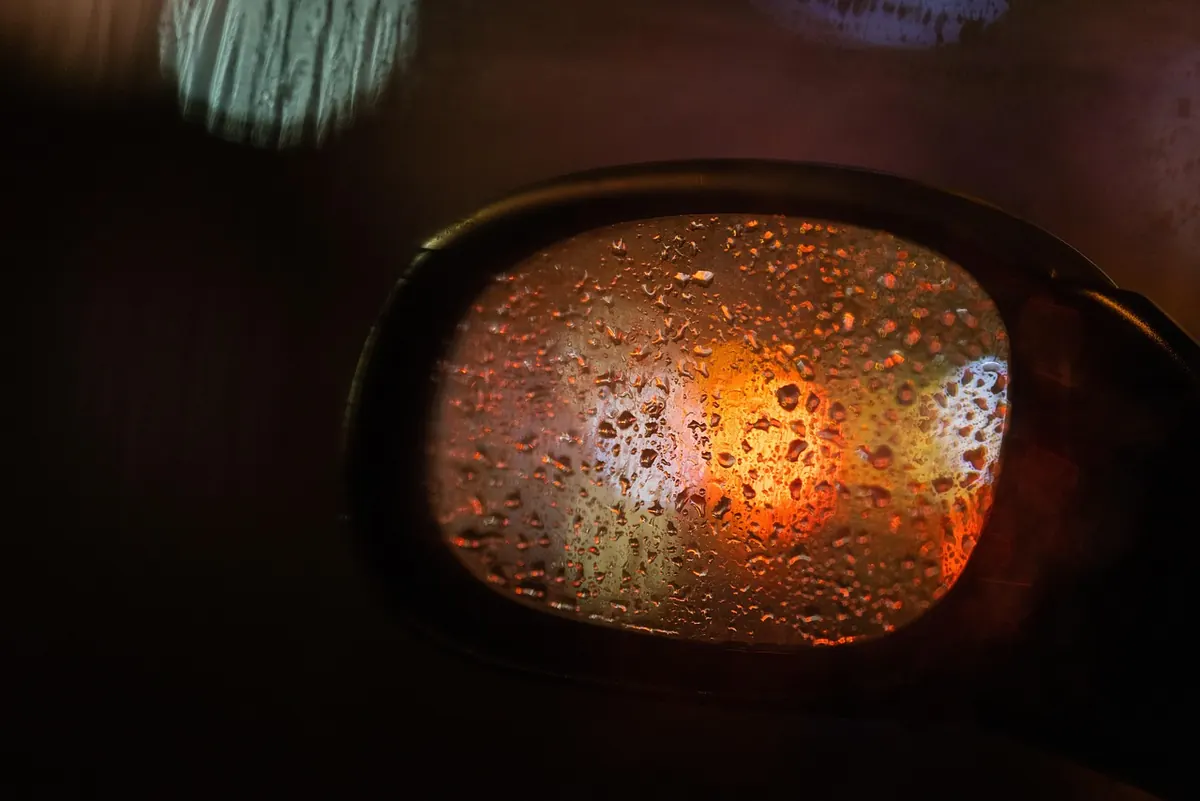
You know the morning. You drop into the driver's seat five minutes later than you meant to, the engine catches, and the windscreen is a grey-white sheet you can't see through. It happens in Aberdeen in January and it happens in Bristol in October. British weather is unusually good at fogging glass, and the answer isn't a bigger scraper.
What follows is a seasonal guide: why our cars mist up so reliably, why dew, frost and condensation need different handling, and a five-minute routine that gets you clear and moving instead of sitting there idling for a quarter of an hour.
Why UK mornings are so good at fogging glass
Fog on glass is a simple equation. Moisture in the air meets a surface cold enough to condense it. Britain supplies both sides of that equation generously. Our air is damp — sea air, rivers, wet ground, last night's rain still evaporating — and our nights cool down sharply after mild days, which is exactly the combination that pushes glass below the dew point.
Your car makes it worse. Overnight, the windscreen radiates heat away to a clear sky and ends up colder than the air around it. Park on grass, beside a wall, under trees or near water and you'll collect more moisture than a car left on a breezy street corner. Then there's the inside: every breath, every wet coat, every damp floor mat and every panting dog adds water vapour to the cabin, where it sits waiting for a cold morning.
Dew, frost and condensation are three different problems
It helps to know which one you're dealing with, because the fix isn't the same.
Dew is outside moisture settling as droplets on the glass. Wipers clear it in a stroke or two, and a quick squirt of screenwash finishes the job. Frost is the same process at below-freezing temperatures, and it needs a proper plastic scraper and de-icer — never boiling water, which can crack the glass, and never a bank card or CD case, which can leave plastic marks and scratches.
Condensation forms on the inside, and it's the stubborn one. It comes from moisture already in the cabin, it reappears while you drive, and wiping it away treats the symptom rather than the cause. Everything below is mostly about this third problem.
A five-minute morning demisting routine
- Set the car up before you drive off. Heater to the windscreen/demist setting, fan on full, temperature to warm or hot, air conditioning on, recirculation off. The air conditioning is doing the heavy lifting — it dries the air, even in winter.
- Switch on every heated element you have. Heated front screen, heated rear window, heated mirrors. They clear glass from the edges inwards and take the load off the heater.
- Wipe the inside while the engine warms. A clean microfibre cloth or a small squeegee, worked in overlapping strokes. Do the whole screen, not just the patch in front of you. A dry cloth is essential; a damp one simply moves moisture around.
- Ease back once it clears. Drop the fan to something comfortable and keep the vents angled at the screen. Leave the air conditioning on for the rest of the journey — it keeps the cabin dry and stops the fog creeping back.
- Don't move until you can see. That means the full windscreen, both mirrors and the side windows. A clear porthole in the corner isn't enough, and driving with a restricted view can land you with a fine and points.
The mistakes that keep the fog coming back
- Wiping with your hand or a sleeve. Skin oils leave a film that smears in headlights and seems to attract moisture.
- Leaving recirculation on. It traps the cabin's own damp air and recycles it onto the glass.
- Keeping the heater cold. Cold air can banish fog for a few seconds, but it doesn't dry anything, so the screen mists over again within a mile.
- Leaving wet kit in the car overnight. Mats, coats, umbrellas and sports bags are reservoirs. Take them in, or at least shake them out.
- Summer screenwash in winter. Diluted fluid can freeze on the glass or in the pipes. Use a screenwash rated for the temperatures you actually get.
- Walking away with the engine running. A running, unattended car is an easy target for thieves, and idling on a public road can attract a penalty in some areas.
Anti-fog treatments: what to look for
An anti-fog treatment works by changing how water behaves on the glass. Instead of forming thousands of tiny beads that scatter light, the water spreads into a thin, even film you can see straight through. That's why a treated screen can be slightly misty and still perfectly usable.
Preparation decides whether it works. Clean the inside of the glass first with a proper interior glass cleaner and a fresh cloth — any grease, nicotine film or old product left behind will fight the new coating. Apply a small amount to a cloth or pad rather than spraying the screen directly, spread it thinly and evenly, then buff off the excess with a dry, lint-free cloth. Less is genuinely more; a thick layer goes streaky. Reapply according to the instructions, and top up the lower half of the screen more often, since that's where the demister vents hit hardest.
Household substitutes are worth knowing about but rarely worth relying on. Shaving foam, a cut potato and diluted washing-up liquid all leave a surfactant film that spreads droplets, but the effect fades within days and can smear badly at night. If you want a low-effort backup, a reusable silica gel dehumidifier bag left on the dashboard overnight genuinely absorbs cabin moisture — dry it out on a radiator and use it again.
Reserve interior treatments for the inside of the glass. On the outside of the windscreen, wiper blades will strip a coating within a few wipes, so keep the glass clean, replace worn blades and let the screenwash do the work.
Habits that stop the fog before it starts
Dry the car at night
Two minutes of tidying the night before saves ten minutes in the morning: empty the door pockets of drinks, hang wet coats up to dry, and shake out the mats.
Keep the air conditioning running
Air conditioning isn't just for summer. Running it for a few minutes on most journeys keeps the system lubricated, the seals supple and the cabin air drier. If you only ever use it in July, expect a musty smell and weaker demisting.
Check the cabin filter
A clogged pollen or cabin filter restricts airflow through the heater and slows demisting noticeably. It's a cheap part and often easy to reach behind the glovebox.
Keep a small kit in the boot
A microfibre cloth, a squeegee, a plastic scraper, a can of de-icer and a bottle of winter screenwash. Stored together, they turn a bad morning into a two-minute job.
When the fog keeps coming back
If your screen mists up within minutes of clearing, even with the air conditioning on and the heater hot, you almost certainly have a moisture source rather than a demisting problem. Common culprits include blocked sunroof drains, a leaking boot or tail-light seal, damp footwells after heavy rain, or a heater matrix starting to weep. Anti-fog sprays will mask all of these for a while, but they won't fix them. If the damp keeps returning, ask a garage to trace the leak — it's usually cheaper to sort early than to deal with rust and a soggy interior later.
One safety point worth repeating: if your screen fogs over while you're driving, pull over somewhere safe and clear it properly. Wiping with one hand and steering with the other, however quick you think you are, isn't worth the risk.
Get the routine into your head — demist setting, air conditioning on, recirculation off, cloth in the door pocket — and most British mornings become a non-event. The screen clears in the time it takes the heater to warm through, and you drive off with a proper view of the road, which is the whole point.
Photo: ninalozej / Pixabay